
Imagine a moment where your child needs immediate help, and you’re the first responder. The thought alone can send chills down your spine, but it's a reality every parent must be prepared for. Being a parent, your priority is your child's well-being and safety. That's why every pediatrician in Mansfield emphasizes the importance of parents learning infant CPR. It’s more than just a skill; it's a lifeline that can make all the difference in those critical moments when every second counts.
When you bring your child to a Mansfield pediatrics TX clinic, the medical professionals aren't just there to check for common illnesses and growth milestones. They’re there to equip you with the knowledge and tools to handle emergencies. Pediatricians understand that accidents and health crises can occur without warning, and having CPR training can empower you to act swiftly and effectively. This training isn't just for your peace of mind; it's a vital component of proactive parenting.
Learning newborn CPR gives you the confidence to face emergencies head-on. It transforms you from a worried bystander into an active participant in your child’s healthcare. Whether it's a choking incident, a sudden cardiac arrest, or an unexpected accident, knowing CPR can help you stabilize your child until professional medical help arrives. Your pediatrician can attest to countless instances where a parent’s quick response has saved a child’s life.
Infant CPR training is accessible and straightforward, making it an essential skill for every parent. It’s about being prepared, having the knowledge to keep your child safe, and knowing that you can make a life-saving difference. When you’re equipped with CPR skills, you’re not just ready for the unexpected—you’re ready to protect what matters most.
The Role of CPR in Pediatric Emergencies: Statistics and Facts

Every year, over 15,000 kids in the U.S. require CPR during their hospital stays because their hearts stop beating. While 80% to 90% of these kids survive the immediate event, most don’t make it through to leave the hospital. These cardiac arrests usually happen in intensive care units or other closely watched settings, often due to serious breathing issues or shock.
In about half of these emergencies, the child’s heart rhythm is very slow and doesn’t pump blood well, and only about 10% of the time is it a type that can be shocked back to normal. Hospitals work hard to spot kids at risk and keep them in monitored areas to catch problems early.
CPR is all about doing strong chest compressions, using a defibrillator quickly if needed, managing breathing and airways properly, giving epinephrine to help blood flow to the heart, and figuring out what caused the heart to stop in the first place. Advanced newborn CPR techniques, like using special machines to keep blood flowing and monitoring body functions closely, are being developed to help even more.
After the heart starts again, there’s a special kind of care that focuses on keeping the body at the right temperature, managing blood flow and pressures, and providing intensive support in the ICU. This post-cardiac arrest care helps improve the chances of survival and reduces the risk of brain damage.
Any pediatrician in Mansfield TX, will stress how important these steps are to help kids recover from such a scary event. By learning CPR and aftercare, you can boost the survival rates and long-term health for any infant.
We cannot overstate the significance of first aid training for parents. Here’s why it’s so important:
Prompt Care and Injury Reduction: First aid skills enable parents to provide immediate assistance, reducing the severity of injuries and enhancing safety in emergencies, whether at home, in public places, or at work.
Boosting Confidence and Skills: Learning first aid not only boosts confidence but also empowers you as a parent. It enhances personal safety and equips you to handle dangerous situations more effectively.
Mental Health Benefits: Being equipped with first aid knowledge and the ability to assist your child during emergency situations contributes to greater self-assurance, reduced anxiety and stress levels.
Enhanced Safety Awareness: First aid training raises awareness about safety, leading to a decrease in accidents and injuries.
Refreshing Your Knowledge: Even if you’ve taken a CPR class in the past, it’s essential to keep this information fresh in your mind. Remember that in an emergency situation, every second counts, and make sure that you don’t want to waste precious minutes trying to remember what you learned.
The Difference Between Adult and Pediatric CPR: What Parents Need to Know

As was mentioned, annually, more than 15,000 children in the U.S. require CPR due to cardiac arrest while hospitalized. Hospitals tend to focus on identifying at-risk patients and keeping them under close watch.
Key components of CPR include strong chest compressions, timely defibrillation if needed, proper ventilation and airway management, administering epinephrine to boost blood flow to the heart, and treating the underlying cause of cardiac arrest. Advanced techniques like extracorporeal CPR and monitoring physiological parameters are being developed to improve outcomes. Post-cardiac arrest care involves managing body temperature, optimizing hemodynamics, and providing intensive support in the ICU, which enhances survival and neurological outcomes.
Understanding the differences in performing CPR on adults, children, and infants is crucial for effective intervention. Compression depth varies: adults need 2-2.4 inches, while children require one-third of their chest diameter, about 2 inches. Compression rates for both adults and children should be around 100-120 compressions per minute. Hand placement also differs: adults require the heel of one hand on the chest center, children older than one year need one or two hands just below the nipple line, and infants need two fingers on the lower half of the breastbone.
Ventilation during CPR provides oxygen to the lungs, maintaining a 30:2 ratio of compressions to breaths for both adults and children. When using an AED on a child, pediatric pads or settings should be used to ensure proper energy levels. Pediatric survival rates are higher with early newborn CPR intervention, emphasizing the importance of knowing these distinctions. At Kidsville Pediatrics Mansfield, we stress these differences to help parents provide life-saving aid effectively in emergencies.
Common Mistakes in Pediatric CPR and How to Avoid Them

When performing infant CPR, mistakes can happen, but you can avoid them by learning the proper way to do it. Becoming comfortable and confident with these critical steps ensures you can perform CPR properly when needed. As recommended by any pediatrician in Mansfield, it's crucial to be prepared.
#1 Not calling 9-1-1: Always call for assistance or direct someone to do so immediately so first responders can be on their way. Performing infant CPR properly requires a lot of physical and mental energy, so having experienced emergency medical support on-scene as soon as possible is essential.
#2 Not properly assessing the situation: Do not turn into the next victim on the scene. Maintain good situational awareness and do a quick risk assessment to ensure the scene is safe before you begin assisting your child.
#3 Not doing the proper compression rate: The ratio of compressions to breaths must be accurately followed. Do your best to maintain a steady rhythm.
#4 Not maintaining proper compression depth: Compression depth varies between adult and child CPR. Your goal is to compress the chest about 1 inch in depth for children and 2 inches for adults.
#5 Not placing your hands properly and maintaining proper form: The rule for adult CPR is to keep your elbows straight and fingers interlocked so the right amount of pressure and force are applied. The heel of your hand should be in the middle of the victim’s sternum or breastbone, aligned with their armpits or nipple line. In child CPR, remember that this becomes different.
#6 Not maintaining a proper ventilation rate: Delivering ventilations too fast or too many times does not allow for proper air exchange within the lungs. Tidal volume is the amount of air needed for air exchange in the lungs, and delivering too much air during ventilations can cause air to move into the stomach and eventually cause the victim to vomit.
By understanding these common mistakes and how to avoid them, you can be better prepared to perform CPR effectively and confidently.
When to Perform CPR on a Child: Recognizing the Signs of an Emergency

Infant or newborn CPR is best performed by someone trained in an accredited CPR course. The latest techniques highlight compression over rescue breathing and airway management, thus, essentially doing a 180-degree turn from a long-standing practice.
All parents and caregivers should learn infant and child CPR if they haven't already. Time is crucial when dealing with an unconscious, non-breathing child. Permanent brain damage begins after just 4 minutes without oxygen, and death can occur as soon as 4 to 6 minutes later.
Automated external defibrillators (AEDs) are found in many public places and are available for home use. These machines come with pads or paddles that you need to place on the chest of an infant during a life-threatening situation. They use computers to automatically check the heart rhythm and deliver a shock if, and only if, needed to restore a normal heart rhythm. When using an AED, follow the instructions exactly.
Keep in mind: the procedures described here are NOT a substitute for infant CPR training and certification.
Causes
There are many reasons a child's heartbeat and breathing might stop. Some situations where you might need to perform CPR on a child include:
Choking
Drowning
Electrical shock
Excessive bleeding
Head trauma or other serious injury
Lung disease
Poisoning
Suffocation
Symptoms
Newborn CPR should be performed if the child shows any of the following symptoms:
No breathing
No pulse
Unconsciousness
How to Perform CPR on Infants and Young Children: A Step-by-Step Guide

Here are the five basic steps for quick reference if you find yourself in an emergency situation requiring you to perform CPR on an infant (a child under one year of age):
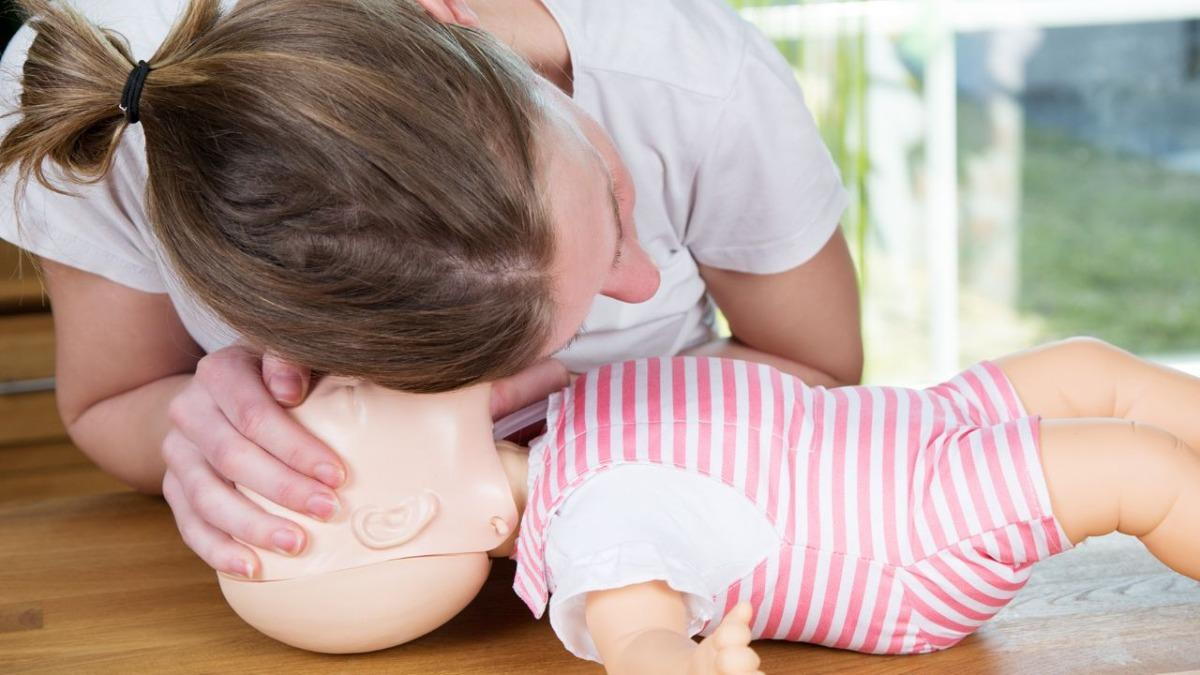
Step 1: Check for responsiveness. Gently tap the infant’s foot or shoulder and yell. If the baby is unresponsive, move on to the next step and call 911 immediately.
Step 2: Give 30 chest compressions. Put the baby on a hard, flat surface. Take 2 fingers and find the center of the chest just below the imaginary line between the nipples. Push down 1/3 the thickness of the chest at a rate of 100 compressions per minute. The AHA recommends pushing to the beat of “Staying Alive” by the Bee Gees.
Step 3: Open the airway. Gently tilt the head back, being careful not to tilt it too far.
Step 4: Give 2 breaths. Cover the mouth and nose with your mouth, creating a seal, and give 2 gentle breaths, watching to see the chest rise and then release.
Step 5: Continue giving infant CPR until help arrives. CPR keeps blood flowing to the brain and other vital organs until advanced medical help can take over.
How to perform CPR on a child (ages 1-8) at Mansfield Pediatrics
Here are the basic steps for quick reference if you find yourself in an emergency situation requiring you to perform CPR on a child (between 1-8 years of age):
Step 1: Check for responsiveness. Shake or tap the child gently. Shout the child’s name or “Are you okay?” If the child is unresponsive and you are alone, move on to the next step. If there is another person with you, tell them to call 911.
Step 2: Give 30 chest compressions. Place the child on their back. (Note: if a spinal injury is possible, two people should move the child, preventing the head and neck from twisting.) Place the heel of the hand on the breastbone, just below the nipples. Keep the child’s head tilted back. Push down 1/3 the thickness of the chest 30 times. The compressions should be fast and hard, without pauses.
Step 3: Open the airway. Lift the chin and tilt the head back by pressing down on the forehead.
Step 4: Look, listen, and feel for breathing. Put your ear close to the child’s mouth and nose, with your face pointed toward their chest. This will allow you to hear breath, feel breath on your cheek, or see the chest rise and fall. If the child is not breathing, continue to step 5.
Step 5: Give 2 rescue breaths. Cover the child’s mouth with your mouth (tightly, creating a seal), and pinch the nose closed. Keeping the chin lifted, give 2 breaths, watching to see the chest rise and then release. Each breath should take about a second.
Step 6: Continue giving CPR (30 chest compressions, 2 breaths, repeat) until help arrives. If you are alone, give CPR for at least two minutes before stopping to call 911. Once you’ve called 911, continue giving CPR until help arrives.
CPR and Choking for Infants: How to Handle Both Emergencies

Choking is especially common in young children, but it can happen to anyone at any age. Choking occurs when the airway is partially or completely blocked by a foreign object like food or a small toy, swelling in the mouth or throat, or fluids such as vomit or blood. When someone is choking, it’s crucial to act quickly because they can become unresponsive and die within minutes.
Children younger than 5 years old are at a higher risk for choking. Infants and toddlers often explore by putting things in their mouths, which can easily lead to choking. Even common foods can be choking hazards for young children. Here's what you should do in an emergency:
Check the scene safety: Make sure the area is safe, form an initial impression, obtain consent if possible, and put on PPE if available.
Check for signs and symptoms:
Weak or no cough*
High-pitched squeaking noises or no sound*
Pale or blue skin color*
Unable to cough or cry*
Panicked, confused, or surprised appearance*
Signs with an asterisk () require immediate emergency medical treatment.
Call 9-1-1: Get emergency equipment and help immediately if the person shows any of the above signs.
Give care:
Choking Infant:Position the infant face-down along your forearm using your thigh for support.
Keep the infant's head lower than their body.
Give 5 firm back blows using the heel of your hand between the shoulder blades.
Turn the infant face-up with their head lower than their body.
Give 5 quick chest thrusts, about 1 ½ inches deep.
Continue giving 5 back blows and 5 chest thrusts until the infant can cough or cry or becomes unresponsive.
If the infant becomes unresponsive, lower them to a firm, flat surface and begin cardiopulmonary resuscitation for infants (starting with compressions) according to your level of training. Trained responders: After each set of compressions and before attempting breaths, open the infant's mouth and look for an object. If you see it, remove it using your pinky. Never do a pinky sweep unless you can see the object.
CPR Certification for Babysitters: Ensuring Your Child’s Safety

CPR is one of the most critical life-saving procedures for babysitting jobs, equipping caregivers with the skills needed to help victims during cardiac arrest, drowning, and choking. Failure to provide necessary help during an emergency can result in death within minutes. Here’s why first aid and CPR classes for babysitters are essential.
First aid training courses cover a wide range of health emergencies, their prevention, and how to attend to them. These include medical emergencies such as excessive bleeding, fractures, sprains, burns, fainting, nosebleeds, animal bites, cuts, bruises, head injuries, and various wounds. Applying the wrong procedure can lead to further damage and injuries. Given the nature of children, babysitters should be confident in their ability to help, depending on the type of injury. Here are the reasons why first aid and CPR training is essential for babysitting jobs.
Children are more prone to accidents than adults due to their limited experience and curiosity. They are susceptible to accidents like suffocation, choking, drowning, falls, cuts, and burns. Proper supervision is crucial to prevent harm in these situations, and caregivers must act quickly to save lives. Infant CPR training equips caregivers with essential skills to handle emergencies and avoid further harm, as children are more sensitive to first aid procedures. Since children may not express themselves during emergencies, adults must be vigilant in identifying potential issues and preventing them.
First aid training also educates caregivers on the causes of health emergencies and how to create a safer environment for children. Preventing emergencies is crucial, as some can be fatal, and children lack the experience to protect themselves. Toddlers, unable to read or understand instructions, rely on caregivers to keep them safe from hazards like electrical appliances, chemicals, and medicines by keeping these items out of their reach.
CPR classes for babysitters provide significant benefits:
Gives Parents Peace of Mind: Many children die in emergencies that could have otherwise been avoided. CPR and first aid training programs help babysitters become more skilled in ensuring children's safety. Hiring a first-aid-trained babysitter will give parents peace of mind as they leave their children. They can trust the babysitter to protect the children from harm. If parents find a babysitter they trust, they might not have to give up their careers to stay home and raise their children.
Improves Healthcare Knowledge of the Babysitter: CPR certification provides babysitters with valuable knowledge and skills to recognize health emergencies promptly. They learn to identify when a child is unwell, call for assistance, and explain the situation to emergency services. First aid and CPR training teach babysitters how to check for signs and symptoms, including temperature, breathing, injuries, and signs of life, enabling them to provide appropriate care. This training helps babysitters stay calm during emergencies, making them more effective responders. Remaining composed allows them to provide necessary care, make quick decisions, and act promptly to save lives.
Furthermore, first aid and CPR certification impart essential life skills that extend beyond caregiving, enhancing the individual’s overall quality of life and their ability to contribute positively to society. The ability to help others and potentially save lives is a rewarding aspect of this training.
Pediatrician Near Me: Kidsville Pediatrics Mansfield, Southlake and McKinney
Should you need additional assistance or guidelines with regard to infant CPR, do not hesitate to:
Schedule an appointment online: https://www.kidsvillepeds.com/appointment/
Or visit/call our clinics:
Kidsville Pediatrics Mansfield TX: 682-341-3910; 1759 Broad Park Circle S, Suite 201 & 205, Mansfield, TX
Kidsville Pediatrics Southlake: 682-345-8010; 2813 W. Southlake Blvd Suite 100 Southlake, TX
Kidsville Pediatrics McKinney: 469-885-9400; 5881 Virginia Pkwy. Suite 300 Mckinney, TX
